Only 40 spots available
Limited travel grants available.
Registration closes August 28, 2026.
The 2026 Rising Stars in Rheumatology Conference is a dedicated educational forum designed to provide in-depth information on rheumatic diseases and disorders, as well as skill-development opportunities tailored to the needs of early-in-practice Canadian rheumatologists.
Conference Objectives:

MD, MSc, FRCPC

MB, ChB, MRCP

MD, MSc, FRCPC

MD, MSc, FRCPC

BA, MD, FRCPC

MD, MHSc, FRCPC

MD, PhD, MSc (Epi)

MD, FRCPC

MD, PhD
9:00 AM – 9:15 AM
Welcome & Opening Remarks
Speakers: Scientific Steering Committee
9:15 AM – 9:45 AM
Lupus Nephritis: Application of New Guidelines
Speaker: Dr. Ann Clarke
9:45 AM – 10:15 AM
Neuropsychiatric Lupus: Diagnosis and Management
Speaker: Dr. Alex Legge
10:15 AM – 10:45 AM
Update on ILD Guidelines in 2026
Speaker: Dr. Shane Shapera
10:45 AM – 11:05 AM
Networking Break
11:05 AM – 11:35 AM
Sjogren’s Syndrome in 2026: What You Need to Know
Speaker: Dr. Alice Mai
11:35 AM – 12:05 PM
ANCA Vasculitis Assessment and Management in 2026
Speaker: TBD
12:05 PM – 1:20 PM
Lunch
1:20 PM – 1:50 PM
Management of RA: New Drugs on the Horizon
Speaker: Dr. Liam O’Neil
1:50 PM – 2:20 PM
Radiologic Approach to Spondyloarthritis
Speaker: Dr. Denis Poddubnyy
2:20 PM – 2:50 PM
Updates on the Use of Checkpoint Inhibitors in Rheumatic Disease
Speaker: TBD
2:50 PM – 3:10 PM
Networking Break
3:10 PM – 3:40 PM
Nociplastic Pain for the Rheumatologist in 2026
Speaker: Dr. Mary-Ann Fitzcharles
3:40 PM – 4:10 PM
The Myositis Maze: Finding Your Way Through Challenging Cases
Speaker: Dr. Eugene Krustev
4:10 PM – 4:40 PM
Pregnancy in Rheumatic Disease in 2026
Speaker: Dr. Évelyne Vinet
4:40 PM – 5:00 PM
Closing Remarks & Adjournment
Speakers: Scientific Steering Committee
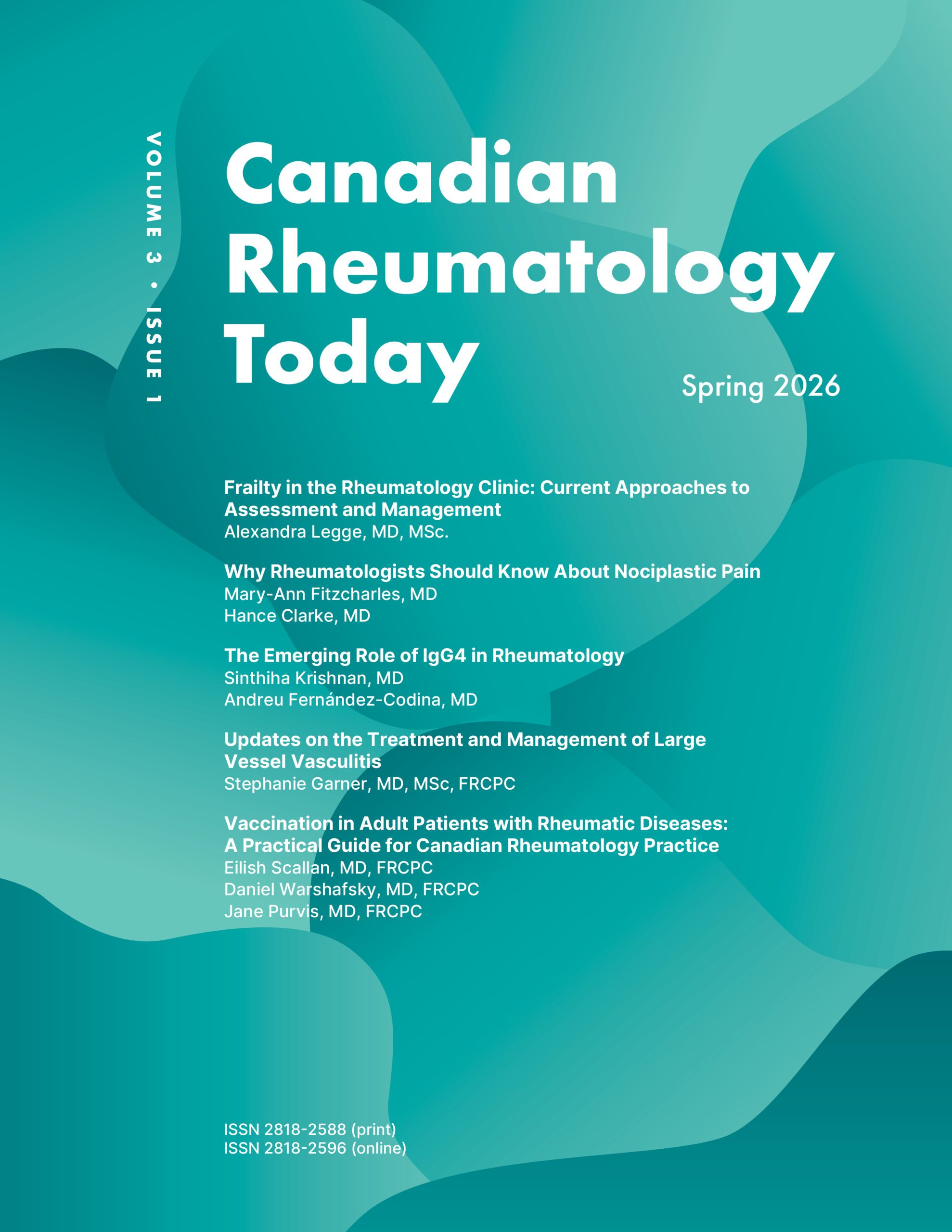
Canadian Rheumatology Today provides a forum for the clinical community to share real-world experience and the latest best practices in the treatment and management of rheumatic disease.
The journal is published thrice-yearly in English and is circulated to over 1,000 Canadian rheumatologists and allied healthcare practitioners. It features peer-reviewed articles that present robust clinical perspectives and practical insights into disease management.
Founded in 2009, Catalytic Health is one of Canada’s largest medical education agencies, the largest independent medical publisher in the country, and an industry leader in innovative events and services for the life sciences industry, reaching over 50,000 Canadian clinicians per year with its educational programs, services and platforms.
© 2026 All Rights Reserved.
Dr. Hugues Allard-Chamard is a highly accomplished medical professional and researcher with a multidisciplinary background.
He earned his MD PhD degree from Université de Sherbrooke, where he successfully merged his interests in rheumatology and pharmacology. During his doctoral research, he made significant contributions to the field by investigating the crucial role of prostanoids and phospholipase A2 in osteoclast biology, shedding new light on osteoimmunology.
His dedication to understanding the intricate relationship between immunology and bone health has earned him recognition among peers and scholars.
Dr. May Choi is a rheumatologist and clinician scientist whose research is focused on biomarker discovery and validation for prediction of clinical outcomes in autoimmune rheumatic diseases, and the prevention of autoimmune disease development and disease-related complications. Her background and training include a Masters of Public Health in Epidemiology at Harvard University and a lupus fellowship at the Brigham and Women’s Hospital. Dr. Choi is also the Associate Director of MitogenDx Laboratory for novel autoantibody and biomarker testing for autoimmune diseases and the Associate Director of Research for the University of Calgary Lupus Centre of Excellence, which complement her research.
Dr. Koppikar is a rheumatologist at Women’s College Hospital and Assistant Professor at the University of Toronto. His clinical and research interests focus on point-of-care musculoskeletal ultrasound in inflammatory arthritis, and he is actively involved in the clinical, research, and educational work of the WCH Psoriatic Arthritis Program. He holds a Master of Health Professions Education from Maastricht University and is the current Education and Basic Course Director for the Canadian Rheumatology Ultrasound Society (CRUS). He also has a strong interest in innovative models of care, particularly in regional and remote settings, and serves as Director of the Timmins Arthritis Program, delivering multidisciplinary arthritis care across Northeastern Ontario.
Dr. Clarke is a Professor in the Division of Rheumatology, Department of Medicine at the Cumming School of Medicine, University of Calgary and held the Arthritis Society Chair in Rheumatic Diseases. Between 1997 and 2013, she was Co-Director of the McGill University Health Centre Lupus Clinic, one of the largest such clinics in North America, and in 2013, she instituted and is the current Director of the University of Calgary Lupus/ Antiphospholipid Syndrome (APS) Centre of Excellence. She has been recognized as a Distinguished Investigator by the Canadian Rheumatology Association. She served as chair of the Systemic Lupus International Collaborating Clinics (SLICC) and is a member of the Canadian Network for Improved Outcomes in SLE (CaNIOS), the Lupus Clinical Investigators’ Network (LuCIN), the North American Lupus Landmark Study, and the international APS Network. Her research focuses on the risk and determinants of malignancy in SLE, the socioeconomic burden of SLE, and clinical trials of novel therapeutics. Dr. Clarke has published over 470 manuscripts and is very engaged in training future generations of lupus clinicians and investigators and advocating for equitable publicly-funded access to emerging lupus therapies.
Dr. Mary-Ann Fitzcharles is a clinician, teacher and clinical researcher at McGill University, Montreal, Canada since 1982. She is a founder member of the Royal College of Physicians and Surgeons of Canada specialty committee for Pain Medicine, is a past chair of the Canadian Rheumatology Association (CRA) Therapeutics committee and has led the Canadian Fibromyalgia Guidelines and the CRA 2019 position statement on Medical Cannabis.
Dr. Eugene Krustev is a rheumatologist and clinician-scientist specializing in idiopathic inflammatory myopathies (IIM). His research focuses on biomarker discovery, disease mechanisms, and novel therapeutics in IIM. He completed his medical training at Memorial University, residency and rheumatology fellowship at the University of Calgary, and a clinical-research fellowship in myositis at Johns Hopkins University.
Dr. Alexandra Legge is an Assistant Professor in the Division of Rheumatology at Dalhousie University in Halifax, Nova Scotia, where she currently holds the Quigley Family Endowed Chair in Rheumatology Research. She is an adult rheumatologist and is currently the Director of the Dalhousie Lupus Clinic and Principal Investigator for the Dalhousie Lupus Clinic Registry. She also collaborates with international lupus researchers as a member of the Systemic Lupus International Collaborating Clinics (SLICC) and Chair of the SLICC World Lupus Committee. One of her research interests is the impact of frailty on people living with rheumatic diseases.
Dr. Mai is a clinical assistant professor for the Division of Rheumatology at UBC. She started the first Sjogren’s clinic in BC, where she sees complex Sjogren’s patients referred from around the province. She is involved with several Sjogren’s research initiatives at this clinic, including participation in international clinical trials for novel Sjogren’s therapeutics.
Dr. Liam O’Neil is an associate professor of Internal Medicine and Immunology at the Max Rady College of Medicine at the University of Manitoba. Dr. O’Neil completed his clinical training in 2017 at the University of Manitoba, and research training at the National Institutes of Health/Duke School of Medicine in 2019. He joined the U of M as faculty in 2020 as an academic rheumatologist and member of the Manitoba Centre for Proteomics and Systems Biology. As a clinician-scientist, his research program focuses on the pre-clinical phase of rheumatoid arthritis, with the ultimate goal of preventing RA in at-risk individuals.
Denis Poddubnyy, MD, PhD, MSc (Epi), is a Professor of Medicine at the University of Toronto.
In 2014, he received board certification in internal medicine and rheumatology and completed his postdoctoral thesis (Habilitation) at the Charité Medical University in Berlin, Germany, focusing on the prediction and prevention of disease progression in early axial spondyloarthritis.
He earned a Master’s degree in Epidemiology from the Institute of Public Health in Berlin in 2016. That same year, he was appointed Professor and Head of Rheumatology at Campus Benjamin Franklin of the Charité, and became the leader of the Spondyloarthritis research group at the German Rheumatology Research Centre (DRFZ).
In July 2024, he was appointed to a full-time clinical academic position in the Division of Rheumatology, Department of Medicine, at the University of Toronto, with the rank of Professor, and as a Senior Scientist at the Schroeder Arthritis Institute, University Health Network, in Toronto, Canada. He serves as Director of the Advanced Imaging Program and Co-Director of both the Psoriatic Arthritis Program and the Clinical Trial Unit.
Since 2003, his research has focused on the early diagnosis, treatment, and outcomes of patients with spondyloarthritis, including psoriatic arthritis. Dr. Poddubnyy is a member of the Executive Committee of the Assessment of SpondyloArthritis International Society (ASAS) and a member of the Steering Committee, as well as the Research and Publication Committees, of the Group for Research and Assessment of Psoriasis and Psoriatic Arthritis (GRAPPA). He also serves on the Research Committee of the Spondyloarthritis Research and Treatment Network (SPARTAN).
He is the author of more than 350 publications, including peer-reviewed journal articles and book chapters.
Dr. Shane Shapera, is a respirologist and Associate Professor in the Faculty of Medicine at the University of Toronto. He is the Director of the Interstitial Lung Disease (ILD) Program at Toronto General Hospital, where he leads a multidisciplinary program focused on the diagnosis and management of complex ILD, including connective tissue disease–associated ILD. Dr. Shapera is actively involved in clinical care, research, and education, with a particular interest in bridging pulmonology and rheumatology to improve outcomes for patients with fibrotic and autoimmune-related lung disease. He also collaborates with the Toronto Lung Transplant Program, contributing to the assessment of transplant canadidacy in patients with advanced ILD.
Dr. Évelyne Vinet is an associate professor in the Division of Rheumatology at McGill and Co-Director of the McGill Lupus Research Clinic. She leads the McGill Reproductive Rheumatology Clinic. Dr. Vinet is also a medical scientist for the Centre for Health Outcomes Research at the Research Institute of the McGill University Health Centre, and a member of the McGill Department of Epidemiology, Biostatistics and Occupational Health.
The primary goal of Dr. Vinet’s research program is to improve reproductive health outcomes in women with rheumatic diseases, such as systemic lupus erythematosus (SLE) and rheumatoid arthritis (RA), and their offspring. To this end, Dr. Vinet has created the world’s largest cohort of offspring born to SLE women, which has driven her novel findings demonstrating that SLE offspring are at increased risk of autism spectrum disorders, congenital heart defects, and stillbirths. Dr. Vinet also led research initiatives to elucidate how therapies used to treat rheumatic diseases (e.g. TNF inhibitors and other biologics) impact health outcomes in these patients and their offspring. Finally, Dr. Vinet is leading an international multi-centre prospective cohort study, the “Lupus in prEGnACY (LEGACY).” cohort, to ultimately establish early risk stratification and personalized therapy of lupus pregnancies.