Only 50 spots available
Limited travel grants are available.
Early registration is recommended.
The 2027 Canadian Hematology Today Symposium on B-cell Malignancies will bring together Canadian hematologists for a focused day of learning, discussion, and exchange on the evolving management of B-cell malignancies.
Conference Objectives:

MD

MD

MD

MD

MD, FRCPC

MD, FRCPC, DRCPC

MD

MD, PhD

MD, FRCPC

MD

MD, MPH, FRCPC
Welcome and Opening Remarks
Speaker: Steering Committee
Keynote
Sponsored Breakfast Symposium
Lymphoma Debate: CAR-T versus Bispecifics in Third Line Follicular Lymphoma
Speakers: Dr. Carla Casulo and Dr. Mary-Margaret Keating
Myeloma Debate: Beyond First Line: CAR-T or Bispecifics?
Speaker: Dr. Cesar Rodriguez and Dr. Alissa Visram
DLBCL Debate: What to Use in First Line?
Speakers: Dr. Gilles Salles and Dr. Nathalie Johnson
Networking Break
Secondary CNS Lymphoma
Speaker: Dr. Juan Pablo Alderuccio
Is Transplant Dead in MCL? A Review of Frontline Treatment
Speaker: Dr. Mark Bosch
Sponsored Lunch Symposium
TBD
Lunch
CLL Debate: VenA versus VenO
Speakers: Dr. Christopher Lemieux and Dr. Mona Shafey
CTCL: A Primer
Speaker: TBD
Vaccines and B-cell Malignancies: What You Need to Know
Speaker: Dr. Clare Sun
Closing Remarks and Adjournment
Speakers: Steering Committee
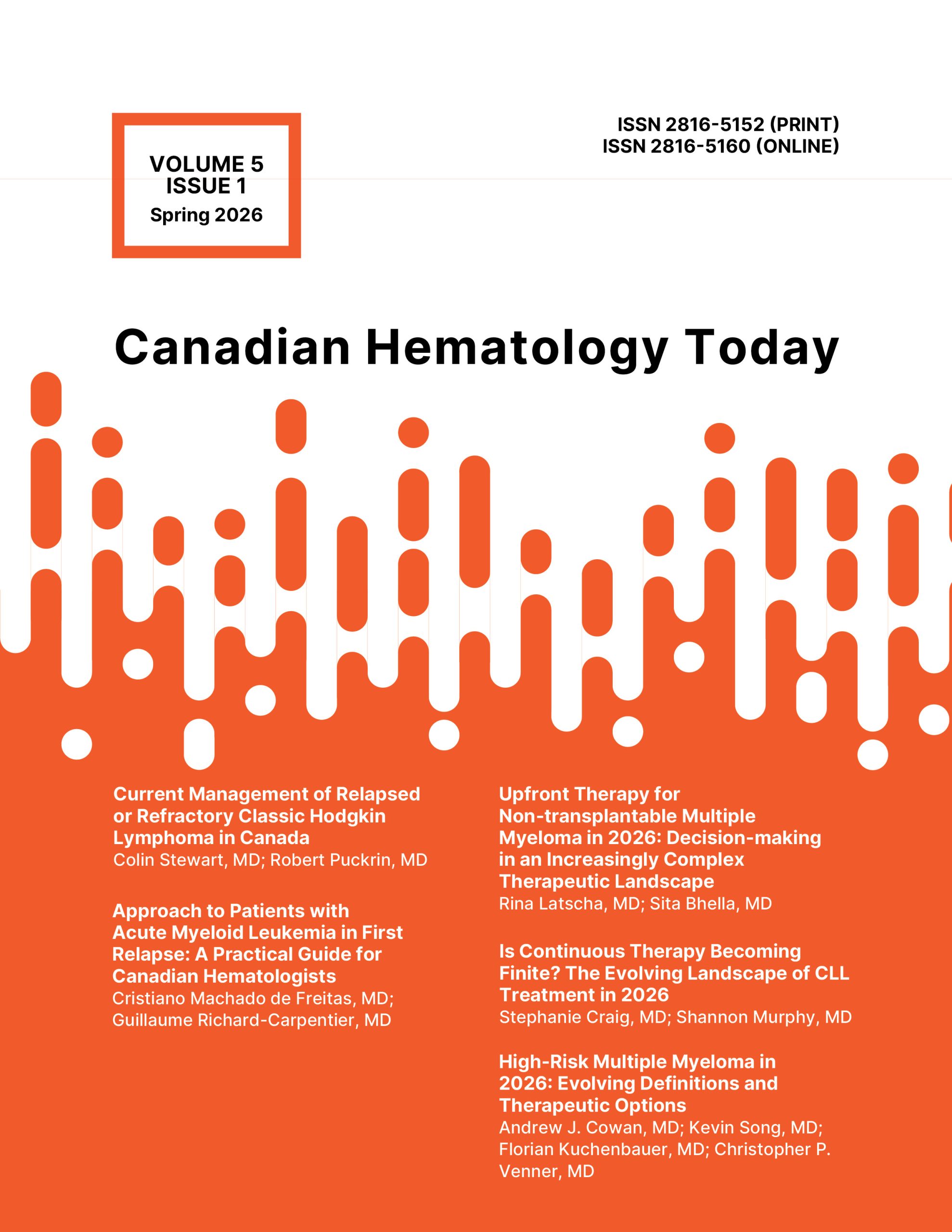
Canadian Hematology Today provides a forum for the clinical community to share real-world experience and the latest best practices in the treatment and management of hematologic disease.
The journal is published thrice-yearly in English and is circulated to over 1,100 hematology clinicians and researchers across Canada. It features peer-reviewed articles that present robust clinical perspectives and practical insights into disease management.
Founded in 2009, Catalytic Health is one of North America’s leading medical education agencies, one of the largest independent medical publishers, and an industry leader in innovative events, conferences, symposia, and services for the life sciences industry, reaching over 75,000 clinicians per year with its educational programs, services and platforms. Its proprietary Rising Stars brand provides educational and networking opportunities for early-to-practice physicians in multiple therapeutic areas, including dermatology, ophthalmology, cardiology, gastroenterology, hematology, and oncology.
To learn more, please visit catalytichealth.com
© 2026 All Rights Reserved.
Dr. Julie Stakiw completed her Bachelor of Science, medical degree, and internal medicine training at the University of Saskatchewan before moving to Ontario to complete her hematology training at Queen’s University, followed by a one-year fellowship in Lymphoma and Stem Cell Transplant at Princess Margaret Hospital. After working as a hematologist-oncologist at Peel Regional Cancer Centre in Mississauga, Ontario, for three years, she moved back to Saskatchewan in 2010 to be closer to family. Dr. Stakiw has held several leadership positions, including Provincial Leader of Hematology for Saskatchewan, Medical Director of the Saskatchewan Blood and Marrow Transplant Program, and, most recently, Medical Director of Oncology at the Saskatoon Cancer Centre.
Dr. Diego Villa is a Clinical Associate Professor at the University of British Columbia and a medical oncologist at the BC Cancer – Vancouver. He is involved in the care of patients with lymphoid malignancies and breast cancer. His research interests include the management of transformed indolent lymphomas, management of mantle cell lymphoma, primary and secondary CNS lymphomas, and the role of PET/CT in aggressive lymphoma. Dr. Villa has ongoing research collaborations with Canadian, American, European, and Australian lymphoma groups. He is also the local principal investigator for various international lymphoma and breast cancer clinical trials open in Vancouver. He actively participates in the teaching of medical students, residents, and fellows at BC – Cancer and Vancouver General Hospital, and is the faculty coordinator for the medical oncology rotation at BC – Cancer for the UBC Internal Medicine Residency Program. Dr. Villa is a member of the UBC Medical Oncology Residency Training Program committee and its Competence by Design subcommittee.
Dr. Juan Alderuccio is a clinical investigator in lymphoma drug development, specializing in B-cell lymphomas. He serves as the Clinical Research Leader of the Lymphoma Section at the University of Miami Sylvester Comprehensive Cancer Center, where he leads a robust portfolio of clinical trials.
Dr. Alderuccio’s research focuses on designing and leading innovative clinical trials, including new therapeutic strategies for difficult-to-treat lymphomas, integrating newer technologies such as circulating tumor DNA into treatment decision-making.
His work has been published in leading medical journals and presented at national and international scientific meetings. Dr. Alderuccio has earned recognition from leading organizations in hematologic oncology, including the Lymphoma Research Foundation and the US Department of Defense. He received the Scholar in Clinical Research Awards from Blood Cancer United and the American Society of Hematology.
Dr. Mark Bosch is a stem cell transplant physician at the Saskatoon Cancer Centre. He completed his medical degree and internal medicine training at the University of Saskatchewan. He completed this subspecialty in Hematology and Bone Marrow Transplant at the University of Calgary. Dr. Bosch is very active in administration, teaching, and clinical research in leukaemia, lymphoma, CAR T and Bone Marrow transplantation.
Dr. Carla Casulo is Professor of Medicine and Assistant Director of Cancer Research Training at the Wilmot Cancer Institute and the inaugural Robert B. Goergen Distinguished Professor in Cancer Care. An international expert in lymphoma, she is known for her pivotal work in follicular lymphoma and has an expertise and passion for young adults with Hodgkin and Non-Hodgkin lymphoma. Her research focuses on identifying risk and individual prognosis to address patients’ treatment needs and sequence of therapy using large international clinical data sets, registries, and developing these findings into novel clinical trials. Dr. Casulo is a member of ASH, ASCO, and the LEO Consortium. A former Scholar and now faculty member in the LRF LSRMP, she also serves on the Steering Committee and was immediate past Chair of the Women in Lymphoma Global Organization, promoting leadership and collaboration in lymphoma research and mentorship.
Dr. Nathalie Johnson is the Director of the division of Hematology at McGill Universityand holds the Louis Lowenstein Chair in Hematology and Oncology. She is a hematologist at the Jewish General Hospital in Montreal who performs translational and clinical research since 2010. Her research focuses on studying mechanisms of therapeutic resistance to conventional and novel therapies and identifying early relapsed lymphoma using plasma circulating tumor DNA. She is the primary investigator of several clinical trials that test novel treatments for patients with newly diagnosed or relapsed lymphoma.She is also the program director for Clinical Investigator Program at McGill University.
Dr. Mary-Margaret Keating is a hematologist and assistant professor of medicine in the Division of Hematology at the QEII Health Sciences Center in Halifax, Nova Scotia. She has a clinical focus in lymphoma and is involved in selecting and overseeing clinical trials for this disease area.
She earned a master’s in medical education from Acadia University and has a passion for teaching medical students, residents and patients. She is the program director for the hematology residency training program and the unit head for the skilled clinician course at Dalhousie Medical School.
Dr. Christopher Lemieux is a Hematologist at the CHU de Québec-Université Laval. He completed specialized training in transplantation and cell therapy at Stanford University in California, for which he received the Detweiler scholarship from the Royal College of Physicians and Surgeons of Canada and the Stephen Couban prize of the Canadian Hematology Society. He is currently director of the CAR-T program at the CHU de Québec-Université Laval and is a member of the immunocellular therapy network in Québec. He is a Clinical Associate Professor of Medicine and director of the Hematology fellowship program at Université Laval.
Dr. Cesar Rodriguez, MD, is an Associate Professor of Medicine at the Icahn School of Medicine at Mount Sinai and Clinical Director of the Multiple Myeloma Center of Excellence Clinic. He completed training in Medical Hematology Oncology and did additional specialized training in cancer biology research and immunology. He focuses on treating patients with plasma cell disorders using early phase clinical trials and novel immunotherapies such as NK and T-cell redirecting therapies. He has been an active advocate for improving access to clinical studies and novel immunotherapies in North and South America. Aside from his patient care, he is performing translational experiments using a three-dimensional organoid tumor model to study the biology of the myeloma tumor niche and as a potential platform for personalized medicine.
Dr. Gilles Salles, MD, PhD, was appointed Chief of the Lymphoma Service at MSK in 2020. He previously held the position of Professor of Hematology and Medicine at the University of Lyon and Head of the Department of Hematology at the Hospices Civils de Lyon, Centre Hospitalier Lyon-Sud, in Pierre-Bénite, France.
Dr. Salles obtained his medical degree and his doctoral degree in differentiation, genetics, and immunology from the Université Claude Bernard Lyon-1. He completed further training as a researcher in oncology at the Dana-Farber Cancer Institute of Harvard Medical School.
Throughout his career, Dr. Salles has been especially interested in the clinical and biological study of lymphoma. The primary focus of his work is on the description and validation of prognostic factors and clinical trials in indolent lymphomas. His team has also examined several aspects of lymphoma biology, including T-cell and B-cell lymphoma models, signalling, and genomic biology of indolent lymphomas.
Dr. Salles has been involved in the investigation and development of new therapeutic agents such as targeted therapies, new monoclonal antibodies, and other immunotherapies in the field. He has led large international studies evaluating treatment options in patients with follicular lymphoma.
A member of several international societies, including the American Society of Hematology, Dr. Salles is also the author of more than 600 publications, including articles in international peer-reviewed journals such as The New England Journal of Medicine, Blood, The Journal of Clinical Oncology, The Lancet, Haematologica, The Lancet Oncology, and Leukemia & Lymphoma.
Dr. Mona Shafey is an Associate Professor in the Department of Medicine, Division of Hematology and Hematological Malignancies at the University of Calgary and Medical Director of the Alberta Blood & Marrow Transplant Program. She completed medical school and residency training at the University of Ottawa in 2008 and completed fellowship training in Hematopoietic Stem Cell Transplantation at the University of Calgary in 2010. Her clinical and research interests are in malignant hematology with a focus on the management of patients with lymphoma and CLL, including the use of cellular therapies (stem cell transplantation and CAR T-cell therapies) in the treatment of these diseases.
Dr. Clare Sun specializes in chronic lymphocytic leukemia (CLL) and Richter transformation. Her clinical practice integrates targeted therapies, immunotherapy, and clinical trials to develop individualized treatment strategies, particularly for patients with relapsed, refractory, or high-risk disease. She is actively involved in clinical research evaluating next-generation therapies for CLL and related disorders and translational research investigating treatment resistance and host immunity.
Dr. Sun is currently an Associate Attending Physician at Memorial Sloan Kettering Cancer Center in New York. She received a B.Sc. with distinction in Life Sciences from Queen’s University in 2006 and an M.D. from the University of British Columbia in 2010. She completed an internal medicine residency at Loyola University Medical Center in 2013 and fellowship in hematology and medical oncology at the National Institutes of Health in 2016.
Dr. Alissa Visram is a hematologist at the Hamilton Health Sciences (HHS) and an assistant professor affiliated with McMaster University. She completed her hematology training at Dalhousie University in Nova Scotia, and her subspecialty clinical and research fellowship in plasma cell disorders at Mayo Clinic. Dr. Visram holds a Masters in Public Health and Epidemiology from Harvard University. She joined the faculty in Ottawa in September of 2021 as a clinician investigator and transitioned to HHS in 2025. Her clinical research is centered on understanding and improving health outcomes of patients with plasma cell disorders and developing cost-effective and efficacious immunotherapies for patients with multiple myeloma.