













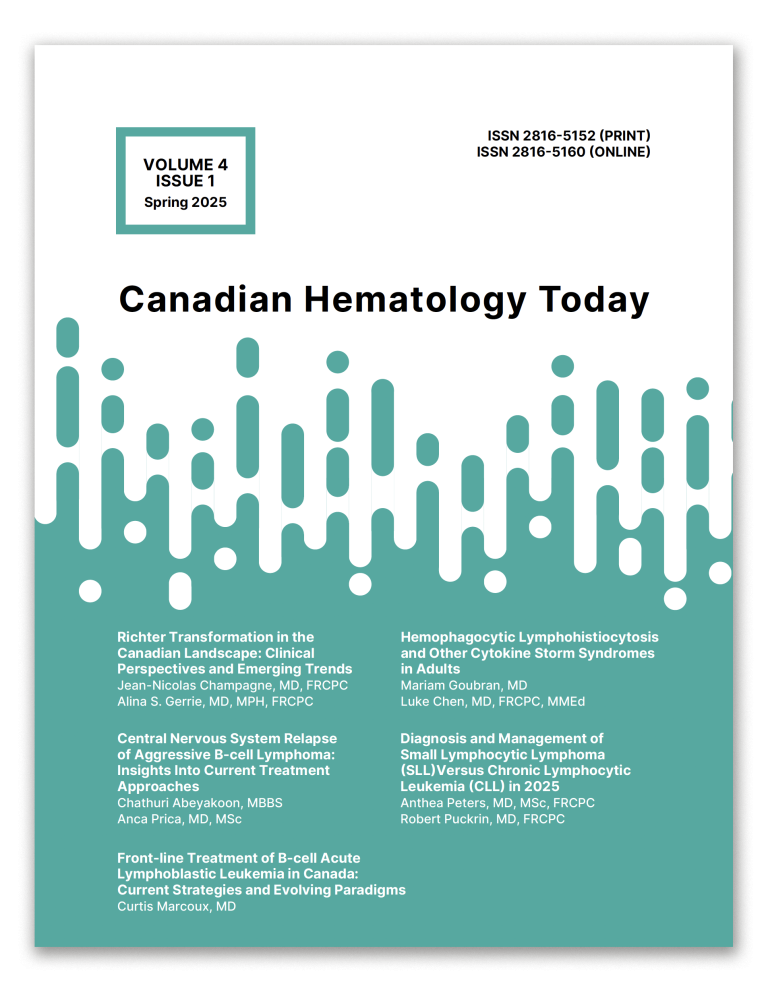

Canadian Hematology Today provides a forum for the clinical community to share real-world experience and the latest best practices in the treatment and management of hematologic disease.
The journal is published thrice yearly in English and French and is circulated to over 1,100 hematology clinicians and researchers across Canada. It features peer-reviewed articles that present robust clinical perspectives and practical insights into disease management.
Founded in 2009, Catalytic Health is one of Canada’s largest medical education agencies, the largest independent medical publisher in the country, and an industry leader in innovative events and services for the life sciences industry, reaching over 50,000 Canadian clinicians per year with its educational programs, services and platforms.
© 2026 All Rights Reserved.
Dr. Diego Villa is Clinical Associate Professor at the University of British Columbia and a medical oncologist at the BC Cancer – Vancouver Cancer Center. He is involved in the care of patients with lymphoid malignancies and breast cancer. His research interests include the management of transformed indolent lymphomas, management of mantle cell lymphoma, primary and secondary CNS lymphomas, and the role of PET/CT in aggressive lymphoma. Dr. Villa has ongoing research collaborations with Canadian, American, European, and Australian lymphoma groups. He is also the local principal investigator for various international lymphoma and breast cancer clinical trials open in Vancouver. He actively participates in the teaching of medical students, residents, and fellows at BCCA and VGH, and is the faculty coordinator for the medical oncology rotation at BCCA for the UBC Internal Medicine Residency Program. Dr. Villa is a member of the UBC Medical
Oncology Residency Training Program committee and its Competence by Design subcommittee.
Dr. Julie Stakiw completed her Bachelor of Science, MD, and internal medicine training at the University of Saskatchewan before moving to Ontario to complete her hematology training at Queen’s University, followed by a one-year fellowship in Lymphoma and Stem Cell Transplant at PMH. After working as a hematologist-oncologist at Peel Regional Cancer Centre in Mississauga, Ontario, for three years, she moved back to Saskatchewan in 2010 to be closer to family. Dr. Stakiw has held several leadership positions, including Provincial Leader of Hematology for Saskatchewan, Medical Director of the Saskatchewan Blood and Marrow Transplant Program, and, most recently, Medical Director of Oncology at the Saskatoon Cancer Centre.
Dr. Allan is an Associate Professor of Clinical Medicine in the Division of Hematology and Medical Oncology at Weill Cornell Medicine. Dr. Allan completed his undergraduate education at the University of Missouri-Columbia and graduated with a B.S. in both Biochemistry and Finance. He subsequently obtained his medical degree from Saint Louis University. Seeking an internal medicine residency program with particular strength in oncology, Dr. Allan moved to New York in 2009 to train at New York-Presbyterian Hospital, Weill Cornell Medical Campus, where he also completed his hematology and medical oncology fellowship.
Dr. Allan treats all lymphoid malignancies and has a particular interest in improving therapies for
patients with CLL and Richter’s Syndrome, which is the focus of his research.
Dr. Castillo was born in Peru, received his medical degree in Mexico City, and completed his training in Internal Medicine and Hematology and Oncology at the University of Massachusetts and Brown University, respectively. Dr. Castillo is an Associate Professor at Harvard Medical School, an Institute Physician at the Dana-Farber Cancer Institute, and the Clinical Director of the Bing Center for Waldenström Macroglobulinemia. Dr. Castillo is the principal investigator in innovative clinical trials evaluating highly effective non-chemotherapeutic approaches for patients with Waldenström macroglobulinemia. Dr. Castillo is a Scientific Advisory Committee member at the International Waldenström Macroglobulinemia Foundation and a Scientific Committee member of the International Workshop for Waldenström Macroglobulinemia. He has authored over 350 peer-reviewed articles and has published his research in high-impact journals, including the New England Journal of Medicine, Lancet Oncology, Journal of Clinical Oncology, and Blood. Dr. Castillo has been awarded the Innovation Award by the Dana-Farber Cancer Institute and the Robert A. Kyle Award by the International Workshop for Waldenström Macroglobulinemia. He is the Founder and Director of the WM-NET, a consortium composed of academic researchers in the United States focused on designing and executing clinical research in patients with WM.
Dr. Michael Chu is a clinician scientist at the Cross Cancer Institute. He completed his medical training including General Internal Medicine residency and Medical Oncology fellowship at the University of Alberta. Dr. Chu was then awarded a Leukemia and Lymphoma Society fellowship for a combined clinical and research fellowship at Stanford University. Upon returning to Edmonton, his clinical focus includes lymphoma and myeloma. Academically, his research focuses on basic and translational cancer research with an emphasis on immune therapy (including monoclonal antibodies and cellular therapy) including one of the first point of care manufactured CAR T-cells in Canada. He also has a wide range of clinical research where he serves as principal investigator and sub-principal investigator on multiple phase I, II, and III clinical trials. Dr. Chu is actively involved in trainee education particularly with the local Medical Oncology fellows providing both didactic and bedside teaching. When not working hard at the Cross Cancer Institute, Dr. Chu is also a loving husband and father while maintaining his interests in various hobbies including basketball, photography, and piano.
Dr. Andrew Cowan is an associate clinical professor at BC Cancer / University of British Columbia, where he specializes in treatment and clinical research on plasma cell disorders. He has an interest and background in early phase cellular therapy and immunotherapy trials, global oncology, and informatics.
Dr Johnson is a medical oncologist specializing in the care of patients with lymphoma and those receiving cellular therapies. After completing his training in internal medicine at MGH and Hematology/Oncology at the Dana-Farber Cancer Institute, he joined the faculty at MGH and Harvard Medical School in July 2021, where he is currently an Assistant Professor of Medicine and the Medical Director for Hospital Performance on Lunder 9, the inpatient lymphoma/myeloma unit.
His research has focused on developing care delivery interventions to enhance patient quality of life, therapy tolerability, and care delivery, clinical trials to improve the care of older adults with aggressive lymphomas, and integrating patient-reported outcomes into clinical trials of novel therapies, including cellular therapies. He has received a Career Development Award from the American Society of Clinical Oncology Conquer Cancer Foundation, an NCI K08 Career Development Award, an ACS Pilot Grant Award, an ASH abstract achievement award, and membership in the Lymphoma Research Foundation Scientific Mentoring Program.
Dr. John Kuruvilla is a Professor of Medicine at the University of Toronto and a hematologist in the Division of Medical Oncology and Hematology at the Princess Margaret Cancer Centre in Toronto. He is a member of the Lymphoma, Autologous Transplant and Immune Effector Cell Therapy programs. Dr. Kuruvilla’s research interest is the development of novel therapeutics in lymphoid malignancies and incorporating translational research into clinical trials. He is the Lymphoma Co-Chair for the Canadian Cancer Trials Group (CCTG) as well as the Chair of the Scientific Advisory Board of Lymphoma Canada.
Philip George Kuruvilla, distinguished in the field of hematology and medical oncology, recently retired but previously served as the Interim Division Chief of Hematology at William Osler Health System, while also holding the role of Medical Oncologist at the same institution. Additionally, he held the position of Assistant Clinical Professor (Adjunct) at McMaster University, where he contributed significantly to medical education and research. Dr. Kuruvilla pursued his medical education at the University of Toronto, where he obtained his M.D. in 1986. Following this, he completed his internship at Toronto Western Hospital and his residency at Toronto Western and General Hospitals. Dr. Kuruvilla further specialized in Medical Oncology through a fellowship at Princess Margaret Hospital in Toronto, where he served as Chief Resident in 1991. Throughout his career, Dr. Kuruvilla has held several prominent positions, including Division Chief of Hematology and Medical Oncology at William Osler Health Center from 2008 to 2013. He also served as Supervisor at the Royal College of Physicians and Surgeons and Regional Quality Lead at Cancer Care Ontario during the same period. Notably, Dr. Kuruvilla has been an active member of various medical associations, including the Royal College of Physicians and Surgeons of Canada, the Ontario Medical Association, the American Society of Hematology, and the American Society of Oncology.
Dr. Eva Laverdure is a hematologist at the Centre Hospitalier Universitaire de Sherbrooke and an assistant professor in the Faculté de médecine et des sciences de la santé de l’Université de Sherbrooke. She completed her hematology training at the Université de Sherbrooke, followed by a postdoctoral fellowship in lymphomas and immune effector cell therapies at Hôpital Maisonneuve-Rosemont, affiliated with the Université de Montréal. Her main clinical interests include lymphomas, chronic lymphocytic leukemia, and the use of T-cell–based immunotherapies.
Dr. Christopher Lemieux is a Hematologist at the CHU de Québec-Université Laval. He completed specialized training in transplantation and cell therapy at Stanford University in California, for which he received the Detweiler scholarship from the Royal College of Physicians and Surgeons of Canada and the Stephen Couban prize of the Canadian Hematology Society. He is currently director of the CAR-T program at the CHU de Québec-Université Laval and is a member of the immunocellular therapy network in Québec. He is a Clinical Associate Professor of Medicine and director of the Hematology fellowship program at Université Laval.
Dr. Kami Maddocks is a Professor of Clinical Internal Medicine and Director of the Lymphoma Program in the Division of Hematology. She specializes in treating patients with B-cell lymphomas. Dr. Maddocks conducts research evaluating new-targeted therapies for these lymphomas, with a particular interest in mantle cell lymphoma and diffuse large B cell lymphoma.
Dr. Maddocks is an investigator on several clinical trials in lymphoma, evaluating non-chemotherapeutic approaches to the treatment of lymphoma and the role of minimal residual disease in predicting outcomes and making therapeutic decisions. She serves on the Alliance Lymphoma Committee, serving as the Alliance Chair on two MCL trials through the AFT and NCTN. In collaboration with colleagues at OSU and Cornell, they were awarded an LLS and NCI P01 to study functional genomics in mantle cell lymphoma therapy and mechanisms of resistance.
Giorgio Minotti, MD, is Professor of Pharmacology and Clinical Pharmacology at the University Campus Bio-Medico of Rome, and Scientific Director of Fondazione Pisana per la Scienza in Pisa, Italy. He is primarily interested in basic and clinical research on new anticancer drugs, with a focus on pharmacodynamic and pharmacokinetic correlates of activity and toxicity, He has worked as a Fellow of the Italian Association for Cancer Research and Fulbright Scholar at Michigan State University, Michigan, USA, and as a Fulbright Visiting Professor at Case Western Reserve University, Ohio, USA. Prof. Minotti is Editor-in-Chief of Chemotherapy, co-founder and European Deputy Editor of Cardiooncology, Associate Editor for the Clinical Pharmacology section of the Journal of Pharmacology and Experimental Therapeutics. He served as expert pharmacologist for the Italian Ethics Committee on Advanced Therapies and Medicinal Products. He received grants from NATO Scientific Affairs, Italian Association for Cancer Research, Italian Ministry for Research and Italian Ministry for Public Health.
Dr. Carolyn Owen is an Associate Professor in the Division of Hematology & Hematological Malignancies at the University of Calgary. She completed internal medicine training in Ottawa, Hematology training in Vancouver followed by a research fellowship in molecular genetics at Barts and the London School of Medicine in London, UK. Her prior research is focussed on familial myelodysplasia and acute myeloid leukemia. Her current clinical interests are low grade lymphoma and chronic lymphocytic leukemia and she is the local principal investigator at the Tom Baker Cancer Centre for several clinical trials in these areas.
Dr. Anca Prica is a staff hematologist at Princess Margaret Cancer Centre, and associate professor in the division of hematology at University of Toronto, appointed in 2014. She did her initial medical training in Toronto, and her clinical training in Internal Medicine and Hematology in the University of Toronto Program. She then did a 2-yearfellowship in Malignant Hematology and a Masters in Health Research Methodology at McMaster University, with research interests in quality of life and economic evaluations. Her clinical work focuses in both lymphoproliferative and plasma cell disorders, as well as autologous stem cell transplantation and CAR-T therapy. Her research interests focus on health services research, particularly economic evaluations and decision analyses for oncologic questions, examining resource use and cost of care, as well as toxicity of chemotherapies, and their effects on quality of life and caregiver burden.
Dr Steven Shih is a haematologist specialising in myeloma and immune effector cell therapy at the Cross Cancer Institute in Edmonton, Alberta. His clinical research focus is on novel drug combinations and immunotherapies in myeloma. Dr Shih completed his clinical and laboratory haematology training in New Zealand, and subsequently a myeloma fellowship at the Princess Margaret Cancer Centre.
Dr. Pamela Skrabek is a Hematologist and Associate Professor in the Section of Hematology and Medical Oncology in Winnipeg with a Masters in Community Health Sciences. Her position is dedicated to clinical work with a focus in lymphomas including a leadership role as chair of the Lymphoproliferative Disease Site Group for CancerCare Manitoba.
Dr Emily Tomasulo is a Hematologist/Oncologist who specializes in B-cell lymphoma and cellular therapy at Pennsylvania Hospital and the Hospital of the University of Pennsylvania. She sits on ECOG-ACRIN Leukemia Committee and her research and clinical interests focus on the use of targeted and cellular therapies in B-cell malignancies with particular attention to cardiovascular adverse effects.
Prior to her position at the University of Pennsylvania, Dr Tomasulo completed her Hematology/Oncology fellowship at the National Cancer Institute in 2023 where she served as Chief Fellow and was an associate and principal investigator on multiple early phase clinical trials.
Dr. Suzanne Trudel is a Professor in the Department of Medicine at the University of Toronto and a hematologist at the Princess Margaret Cancer Centre with a special interest in multiple myeloma. She is a Scientist at the Ontario Cancer Institute and a Faculty Member in the Department of Medical Biophysics.
Dr. Trudel is a principal investigator on clinical trials for relapsed multiple myeloma with a research focus on drug development and precision medicine. She is a member of the Myeloma Canada Advisory Board and has served on the Steering Committee for the Multiple Myeloma Research Consortium (MMRC) as well as the Subcommittee on Correlative Sciences for the National Cancer Institute of Canada Clinical Trials Group.
Dr Young is currently a Clinical Molecular Geneticist at the Cancer Genetics & Genomics Laboratory, BC Cancer. He completed his undergraduate studies in Biochemistry at the University of Waterloo (1992), obtained a Master’s degree in chemistry from Laurentian University (1995), and subsequently completed his doctoral studies at the University of Ottawa in human molecular genetics under the supervision of Dr Robert Korneluk (2000). After a brief stint in discovery science, Dr Young trained in clinical molecular genetics (BC Children’s Hospital) and was certified by the Americal Board of Medical Genetics and Genomics (ABMGG, 2005) and the Canadian College of Medical Geneticists (CCMG, 2006).
As a Clinical Molecular Geneticist, Dr. Young has been involved in the results interpretation and reporting of the bulk of molecular genetic tests stemming from CGL. His main interests lie in molecular genetic service delivery, molecular monitoring (MRD), and the development of new tests and testing paradigms.